


Flag buying guide
Choosing between feather flags and teardrop flags starts with your message and display location. Both give a business or event a vertical advertising format, but their different outlines change how you arrange a logo, headline, and supporting graphics.
This guide compares feather flags vs. teardrop flags so you can choose a shape, plan readable artwork, and order compatible display hardware. Start with what visitors need to notice, then build the flag around that purpose.
What is the difference between feather flags and teardrop flags?
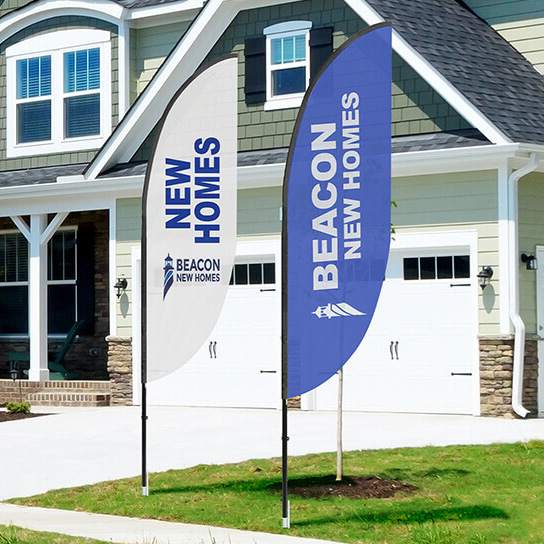
Feather flags have an elongated, feather-like profile. Teardrop flags have a rounded outline that narrows toward the bottom. Both are standing flag styles that need compatible poles and a suitable base.
The silhouette affects the artwork layout. Compare your actual logo and wording inside each product template rather than assuming one shape gives every design more usable space.
| What to compare | Feather flags | Teardrop flags |
|---|---|---|
| Outline | Elongated feather-like profile | Rounded teardrop profile with a tapered lower section |
| Layout starting point | A short headline arranged along the vertical format | A compact logo or message positioned inside the curved outline |
| Potential uses | Storefront announcements, entrances, promotions, and events | Business branding, event displays, property promotions, and entrances |
| Printed sides | Single- and double-sided configurations are available | Single- and double-sided configurations are available |
| Hardware | Confirm pole, base, and size compatibility | Confirm pole, base, and size compatibility |
On smaller screens, scroll the table sideways to read all columns.
Choose the shape around one clear message
A short announcement such as “Now Open,” “Open House,” or “Welcome” gives you a useful starting point. Try the same wording in both templates and compare which version keeps it large, balanced, and easy to recognize.
For a feather flag, consider a concise headline that uses the elongated format without becoming a long stack of small words. For a teardrop flag, keep the main message within the broader central area instead of pushing lettering into the tapered end.
If your design needs a more rectangular vertical area, compare straight flags before squeezing everything into a curved template. Shortening the message may still be the better first step.
Decide between single-sided and double-sided printing
Think about how people approach the display. Single-sided flags show the design through the reverse of the fabric, so lettering appears reversed from that side. A visible reverse image is different from separately printed artwork that reads correctly from both directions.
Double-sided configurations use printed fabric on both sides with a blocker between them. Consider this option when the business name, wording, or directional artwork needs the intended orientation from either side.
For arrows, review both sides of the proof against the real location. Correctly printed artwork still needs to point visitors toward the intended entrance.
Check the overall height and available space
Flags on the Cheap lists standing-flag sizes by complete stand height. The fabric is shorter than the assembled display, so do not treat the advertised height as the height of the printed artwork.
Measure the location for the assembled flag and base. Check overhead clearance, nearby signs, the space around entrances, and the route visitors will use. A larger flag may support a larger message, but it also needs a suitable location.
Evaluate the view from the likely approach direction. A flag partly hidden behind a parked vehicle or another display may be difficult to notice regardless of its shape.
Match the flag base to the display surface
Review flag stands, bases, and accessories alongside your flag. A ground stake and a base that rests on a floor solve different display needs. Choose around the surface and the selected product’s instructions.
Confirm what the order includes. Some accessories are bases only, while a kit may include poles or other components. Similar-looking hardware should not be assumed to fit every flag shape or size.
For outdoor displays, follow the equipment’s operating guidance and monitor changing conditions. Neither shape makes an installation windproof. Keep the flag and its base clear of walkways and required access routes.
Prepare artwork that remains readable
Use the template for the exact shape and size you select. Keep important text, logos, and directional details inside its safe area. Stretching a rectangular design to fill a curved outline can distort the artwork or crowd the edges.
Choose strong contrast and clear lettering. Use original, high-quality logo files, and leave enough space around the headline. A short website address can support the message when people can read it; a long contact block usually competes with the main announcement.
Preview the artwork at a realistic viewing size. Ask someone unfamiliar with the design what they notice first. If they cannot identify the main message quickly, simplify it before reducing the text size.
Review your flag order before checkout
- Confirm the shape, overall height, and intended display location.
- Choose printed sides based on how people will approach the flag.
- Check spelling, logo proportions, and any directional arrows.
- Verify that the selected poles and base fit the flag configuration.
- Check which components are included and the delivery estimate for your setup date.
Frequently asked questions
Are feather flags better than teardrop flags?
The better choice depends on the message, artwork, and location. Compare the same design in both templates, then choose the layout that stays clear and fits the available space.
Can both flag styles be used indoors?
Both styles offer indoor display options when paired with suitable hardware. Confirm the selected base, ceiling clearance, and venue requirements before setting up.
Do I need double-sided printing?
Consider it when people need to read the message correctly from either side. Single-sided printing remains visible from the back, but the lettering appears reversed.
Can I use my existing flagpole and base?
Check compatibility with the exact shape, size, and flag system. Confirm that your existing components match the new flag rather than relying on appearance alone.